PinnedFoundry·July 13, 2026
Foundry and ScottyLabs
Why ScottyLabs runs Foundry.
by Theo Urban·1 min read
The blog
Essays, reflections, and lessons from inside the accelerator.
Why ScottyLabs runs Foundry.

A look into 996 Ventures: Documenting the Obsessed Few
A learning document from the first year of ScottyLabs Foundry
Carnegie Mellon's premier startup accelerator for serious founders.
Carnegie Mellon's First Student-Led Startup Accelerator.

AI is now. Robotics is next.
The most honest benchmark for a frontier model is not a test score. It is what one person can ship in a day.
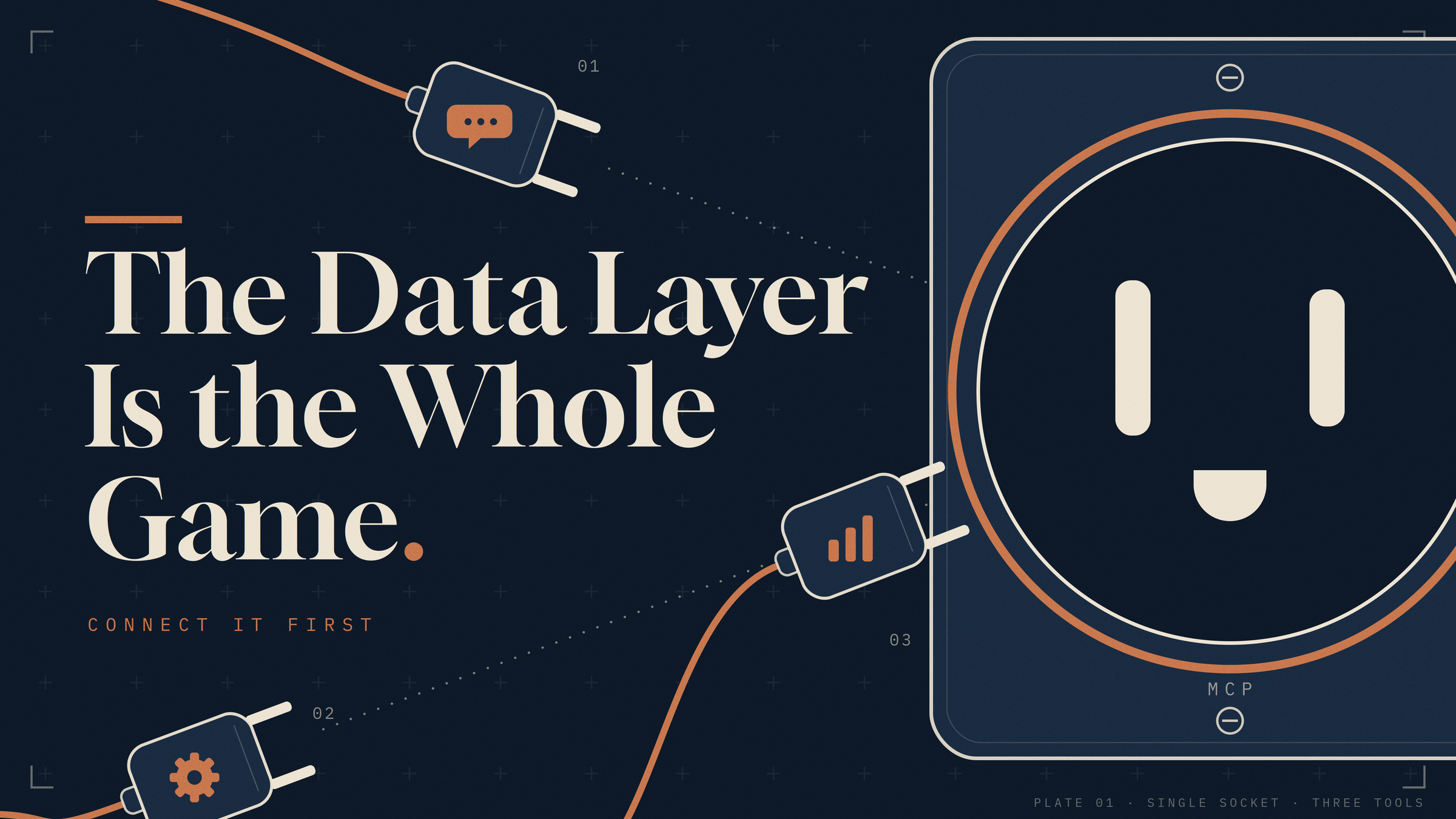
Every business sitting on rich data is one good decision away from making it useful. The decision is to connect it first.

Every business sitting on rich data is one good decision away from making it useful. The decision is to connect it first.
Most of the conversation about AI in business right now is happening at the wrong altitude. People want to talk about the demo: the chatbot that answers customer questions, the assistant that drafts the email, the agent that books the meeting. Those things are real, and some of them are useful. But they all sit on top of a problem almost nobody wants to discuss, because it is not glamorous and it does not photograph well in a pitch deck. The problem is that your data is scattered, locked inside a dozen systems that do not talk to each other, and unreachable by the very tools that are supposed to make it valuable.
In my own work, across companies that range from small operations to the Fortune 500 and across industries as different as pharmaceuticals and private equity, the pattern is the same everywhere. The companies that get real value out of AI are not the ones with the cleverest application. They are the ones who did the unglamorous work first. They made their data reachable, secure, and ready, and everything else followed from that.
That foundational work has a name now, and it is worth understanding even if you never write a line of code.
MCP stands for Model Context Protocol. Strip away the jargon and it is a standard way to let an AI system reach into your tools and data without someone hand-building a custom bridge for every connection. Before a standard like this, hooking a model up to your CRM, your accounting software, your inventory system, and your support tickets meant four separate integration projects, each one fragile, each one a thing that breaks the moment a vendor changes something. MCP turns that into a common interface. You stand up a server for a data source once, secure it properly, and from then on any capable AI system can use it.
Think of it the way you think about a wall outlet. You do not rewire the house every time you buy a new appliance; you plug into a standard socket. MCP is the socket for your business data. The appliances will keep changing, since the AI you rely on today may not be the one you rely on in two years, but the wiring stays.
The part that matters most, and the part the demos skip, is authentication and security. A properly built MCP layer is not a back door. It sits behind OAuth, it respects the permissions a given person already has, and it gives you a controlled, auditable way for AI to touch sensitive information. When the data in question is patient records, deal flow, or customer financials, that is not a nice-to-have. It is the entire point, and it is the first thing a serious practitioner designs for and the first thing an amateur forgets.
Here is what changes once the foundation is in place: the hard, expensive, slow part of working with your data is over, and almost everything you build on top of it becomes fast and cheap.
Say you want a custom internal application, the kind of thing that would have been a six-month software project a couple of years ago. With the data already reachable and an AI coding tool like Claude Code at your engineer's side, a working version can come together in days, because the difficult plumbing is finished and the model is mostly handling the straightforward part on top.
Say you want to automate a real business process rather than a toy one. SAP did not become one of the largest software companies on earth by accident. It happened because business processes are the actual machinery of a company, and getting them right is worth enormous money. Once your data is connected, you can put an automated workflow or an AI agent on top of a process and trust it to run, because it can finally see everything it needs to see.
And you can do things that were simply not possible when your systems lived on separate islands. One example I run for clients: take social listening data, the public conversation happening about a brand, and set it next to actual sales numbers. Now you can ask a question that used to be unanswerable. Did that post move product? At which locations? For which line of business? When two data sources that never touched before end up in the same room, the analysis gets sharper, the decisions get better, and the effect shows up where it counts, on margin and on the bottom line.
None of these are moonshots. They are easy wins. They are only easy, though, after the foundation exists. Skip the foundation and every one of them turns back into a custom, brittle, expensive ordeal.
This is where most companies go wrong, and the mistake is expensive, so let me be direct about it.
You do not need a ten-person engineering team to do this. You need one or two people who are genuinely excellent. The whole point of modern AI tooling is that a small, senior team can now do what used to take a department. Call it the one-person engineering pod, and understand that it is one of the most underrated shifts happening right now inside companies that are not themselves tech companies but are sitting on rich, valuable data.
The catch is that you need the right person. This is not a job for a generic IT hire whose instinct is to keep the printers running. It is not a job for a general software engineer who has never thought about how a model uses a tool or how data should be exposed safely. The person you want is an AI software engineer: someone fluent in the model layer, in software, in the MCP protocol itself, and, above all, in security. This work touches your most sensitive data. The cost of doing it carelessly is not a slow afternoon; it is a breach. You hire here for judgment and specialization, not for headcount.
The good news is that someone who actually knows this work can move astonishingly fast, because the approach is templatable. The first time you stand up a secure, authenticated data layer, it is real work. The second and third time, across different clients and different stacks, it is a repeatable pattern. Experience compounds here the same way the technology does.
I want to end on a thought that points past any single company.
For years the startup world has been fixated on the application layer: the app, the interface, the feature. That made sense when applications were hard to build. But applications are getting cheaper to build by the month, because the models writing them keep improving. When the thing on top is commoditizing, the value moves down, to the layer that is hard, durable, and specific to you. That layer is your data and the secure infrastructure that connects it.
This is why the businesses that move now will pull away from the ones that wait. Not because they bought a flashier tool, but because they did the patient, foundational work that makes every future tool useful the day it arrives. They became AI-native at the layer that actually matters, and everything else, the apps, the agents, the workflows, becomes almost trivial to add once that groundwork is set, whether you build it with the AI of today or whatever shows up next.
The plumbing is not the boring part of this story. The plumbing is the story. Connect your data, secure it well, and you have turned a pile of disconnected systems into the most valuable asset your company owns. Do it now, while it is still a decision and not yet a scramble to catch up.
Contact the author
Thomas Kanz at [email protected]