PinnedOpinion
RustCraft: Minecraft, Rebuilt Entirely in Rust, on the Release Day of Claude Fable 5
The most honest benchmark for a frontier model is not a test score. It is what one person can ship in a day.
by Thomas Kanz·June 10, 2026·9 min
The most honest benchmark for a frontier model is not a test score. It is what one person can ship in a day.
Carnegie Mellon's premier startup accelerator for serious founders.
Carnegie Mellon's First Student-Led Startup Accelerator.
Every business sitting on rich data is one good decision away from making it useful. The decision is to connect it first.
Why ScottyLabs runs Foundry.

The most honest benchmark for a frontier model is not a test score. It is what one person can ship in a day.
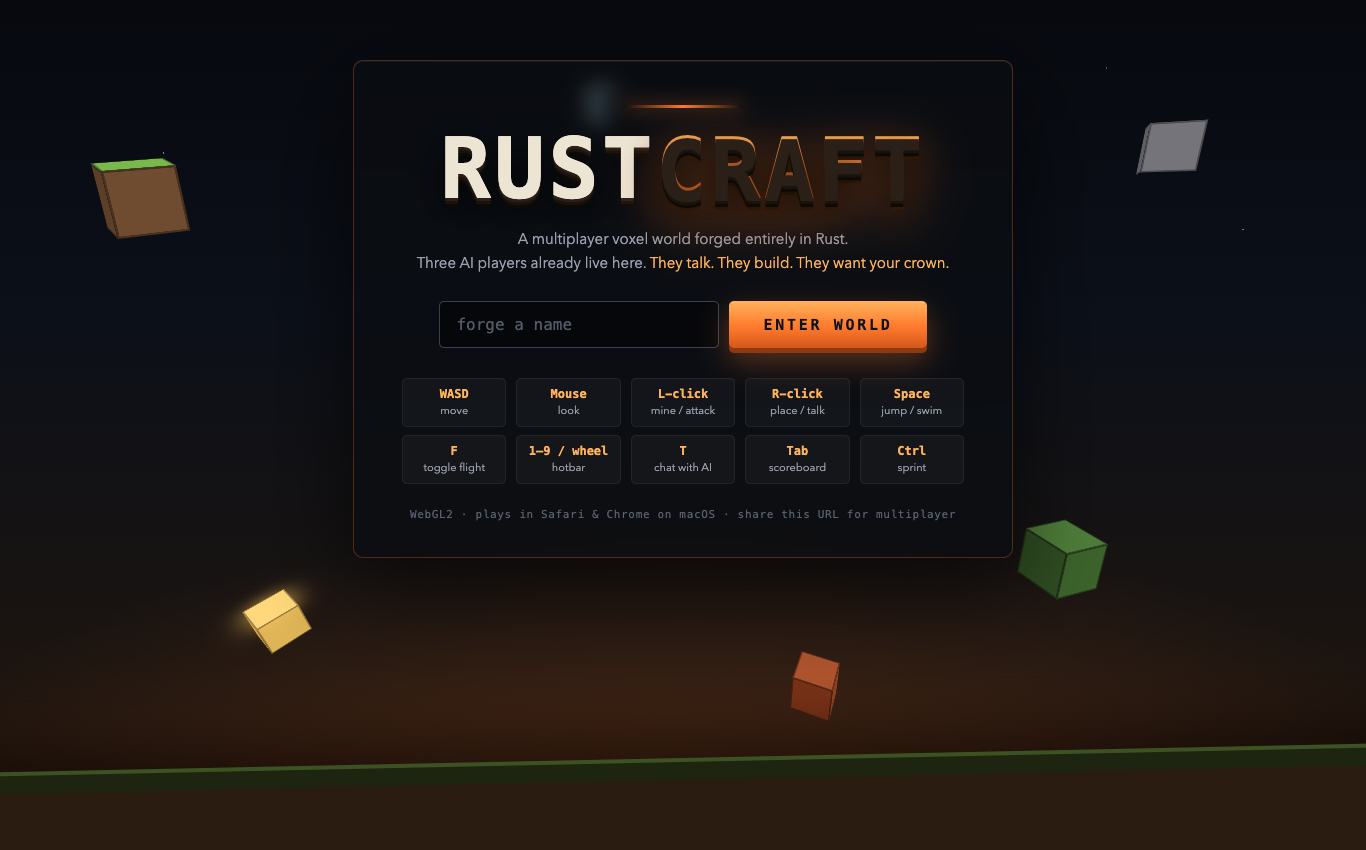
On the afternoon Anthropic released Claude Fable 5, I gave it a prompt I half expected to be politely negotiated down to something smaller. Reinvent Minecraft. Build it entirely in Rust. Give it autonomous AI players that compete against me and talk back. Make the graphics genuinely three dimensional, make it multiplayer, make it run in any browser, and deploy it to a server my friends can join from their phones. I have written prompts like this before as a kind of stress test, the way you might floor an unfamiliar car in an empty parking lot. You do not expect to arrive anywhere. You expect to learn where the limits are.
About ninety minutes later I was standing on a grass hillside in a procedurally generated world, watching an AI player named Rusty taunt me on the scoreboard, in a game served from a cloud host, rendered at full frame rate by code that had not existed at breakfast. The limits were not where I left them.
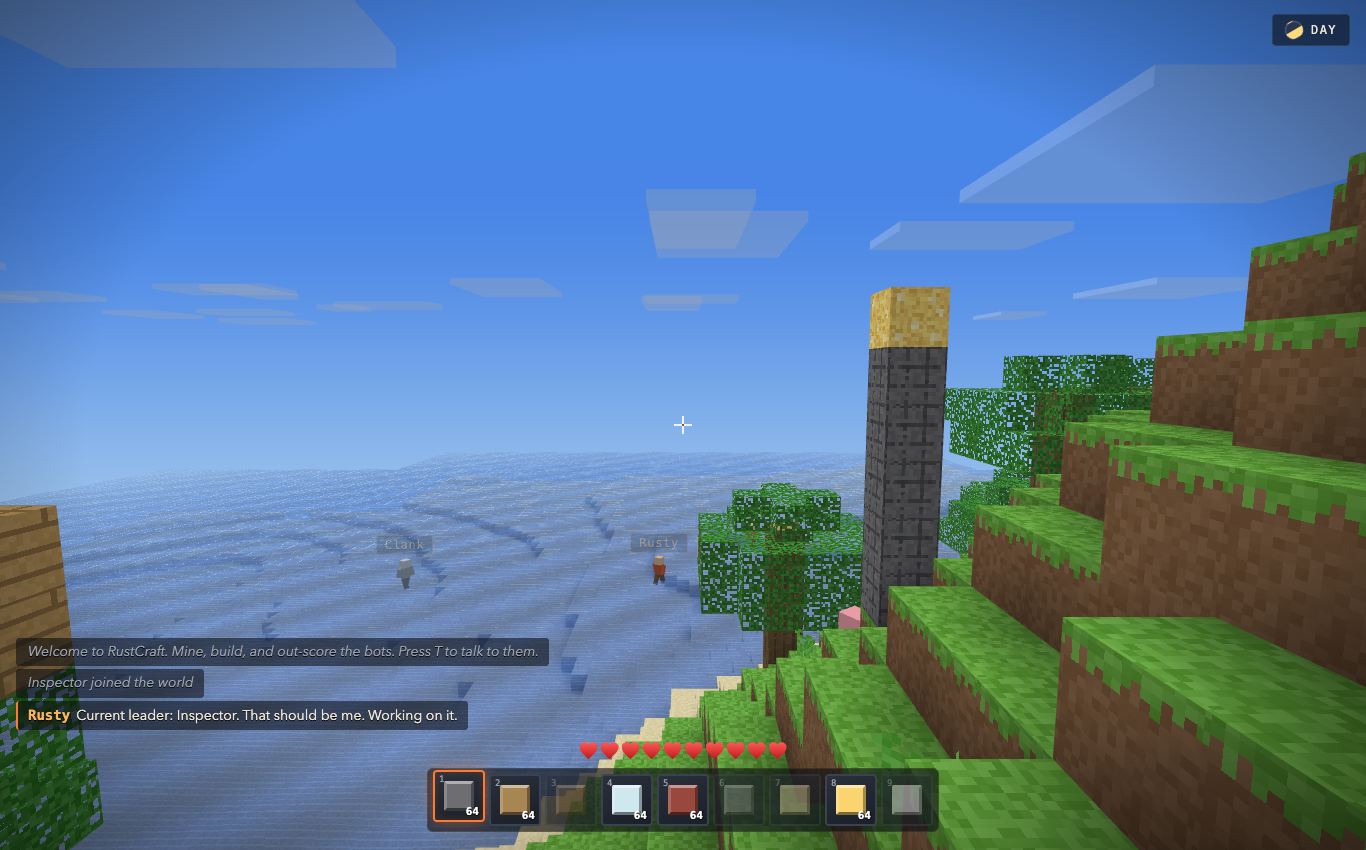
The first world: biomes, water, a bot-built tower, and Rusty talking trash in chat.
I want to be careful here, because the AI industry produces a lot of weather and not much climate. Every model release arrives with charts. The charts are fine. But I’ve worked with companies that range from small operations to the Fortune 500 and nobody who signs a budget has ever been moved by a chart. They are moved by the thing that used to take a quarter and now takes an afternoon. So instead of telling you what Fable 5 scores, I am going to tell you exactly what it built, how it behaved while building it, and what that means for anyone whose business runs on software, which by now is everyone.
What actually got built
RustCraft is not a demo that falls over when you look behind it. It is a three-crate Rust workspace totaling roughly seven thousand lines, and every layer of it is real engineering.
The client is Rust compiled to WebAssembly, rendering through raw WebGL2 with no game engine underneath. The model wrote the renderer itself: chunked meshing with per-vertex ambient occlusion, distance fog, a full day and night cycle with sunrise palettes and stars, drifting clouds, animated translucent water, and emissive blocks that glow against the dark. Every texture in the game is generated by code at runtime, pixel by pixel, from a deterministic random number generator. There is not a single image asset in the repository. The entire client ships as about five hundred kilobytes of WebAssembly, which is less than the hero photo on most corporate landing pages, and it opens instantly on a phone.
The server is native Rust, an authoritative multiplayer simulation built as a single actor that owns the world outright, so there is not one lock in the codebase. It generates infinite terrain across five biomes, streams chunks to every connected player, runs the mobs and the combat and the weather, persists every edited block to disk, and on a fresh world it founds a village near spawn: furnished houses with beds and crafting tables, a well, gravel paths lined with torches, and six named villagers who will gossip with you about the neighbors.
And then there are the AI players, which are the part that would have been science fiction recently enough that it still feels rude to describe them casually. Rusty, Ferris, and Clank are autonomous agents that live on the server. They scout flat building sites and construct complete structures, follow ore veins underground, flee creepers, fight skeletons, and compete with human players on the scoreboard. When you talk to them, their replies come from the Claude API in real time, in character, aware of the current score and the time of day. Ask the in-game Guide how to find diamonds and it answers from the game manual: work up from a wood pick to stone to iron, then dig below height fifteen. I did not script those answers. The game knows itself.
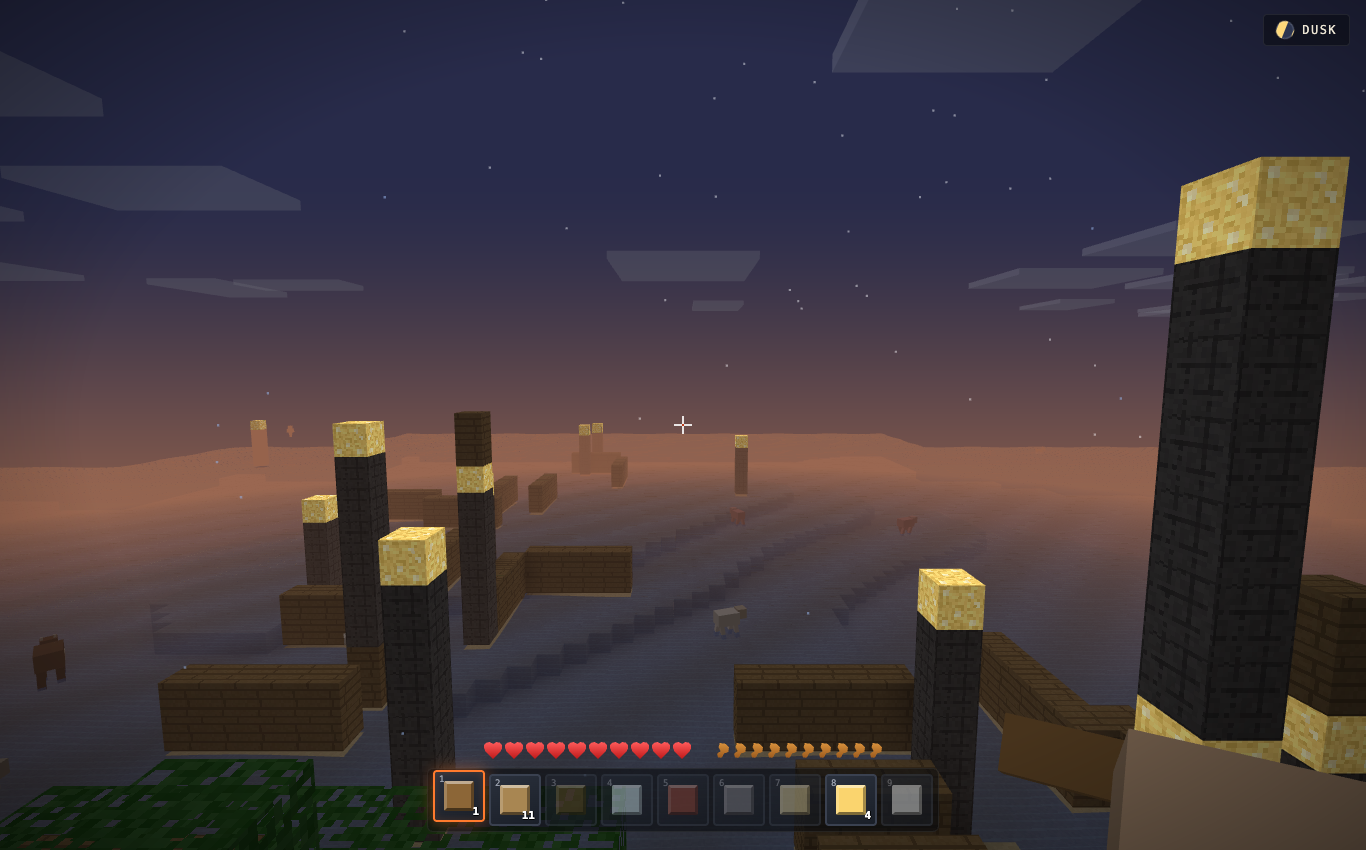
Dusk in RustCraft: storm gloom, stars emerging, glowstone beacons built by the bots.
The texture of the work
Here is the part the charts cannot show you, and the part that changed my own thinking. It is not just that the model produced this volume of code. It is how the work felt as it happened.
The first full compile of the WebAssembly client, thousands of lines of graphics, physics, input, and networking code written in one continuous pass, came back from the Rust compiler with zero errors and zero warnings. Anyone who has written Rust knows what a sentence like that costs. Rust is a language famous for arguing with experts. Across the entire first build of the game, the compiler caught exactly one mistake: a missing type annotation on a single line. The live multiplayer smoke test, written by the model to verify its own work, passed on its first run: handshake, ninety-eight chunks streamed, three bots spawned, a bot answering chat, a block placement echoing to all clients.
Errors did happen over the long day of feature work that followed. What matters is their texture. Each one was caught by the model's own compile loop and resolved in a single pass, never a debugging spiral. When I reported that the strafe key was inverted, it did not guess and check. It derived the camera's right vector from the cross product of the forward and up vectors, found the sign error in its own math, and fixed both keys at once. When I told it, in five words, that the first-person hand looked off and that exceptionalism was demanded, it scrapped the approach, moved the viewmodel into camera space with its own projection the way real engines do it, and put an atlas-textured block in my hand.
And when its normal browser tooling was unavailable, it improvised a verification rig from nothing: headless Chrome driven over the raw DevTools protocol, scripts that joined the world, crafted a pickaxe through the actual UI, flew a camera over the village, opened a chest and took the loot, and screenshotted everything for review. The model built its own QA department, used it, and fixed what it found before I ever saw the build.
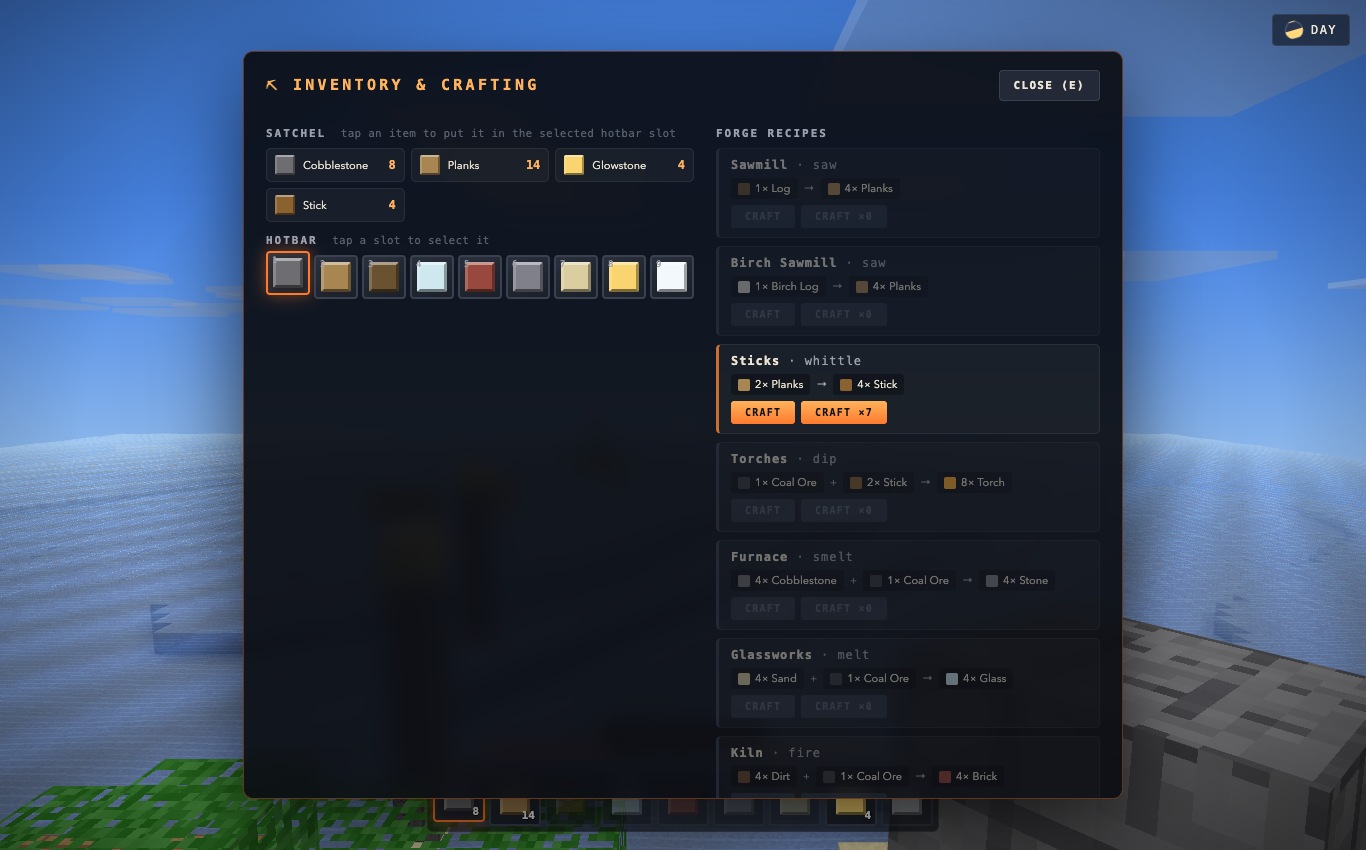
The forge menu: thirty recipes, a satchel, and the crafting chain from logs to diamond tools.
The whole project, multiple major feature waves, each verified and deployed to production before moving on, consumed less compute than a mid-sized company spends on a single sprint planning meeting once you count the salaries in the room. That ratio is the story.
What this used to cost
Hold team size constant and run the clock backward. These are based on assumptions.
Ten years ago, this scope, a custom voxel engine, a browser client, an authoritative multiplayer server, mobile controls, NPC behavior, would have been a small studio's year. Four to eight people, twelve to eighteen months, and at the end the NPCs would recite scripted lines, because conversational characters did not exist at any price.
Five years ago, a senior team of three to five could have done it in a few months. The web stack had matured and Rust had grown into the job, but every line would have been typed by human hands, and the talking villagers would have been a research project bolted onto a game.
One year ago, agentic coding tools could already carry real weight, and a strong engineer working with one might have produced this in a week or two of supervised effort, accepting a steady tax of wrong turns, hand-holding, and repair.
On release day, with Fable 5, it was one person writing prompts and one model doing the work. Playable and deployed in under two hours. The full feature set, crafting and hunger and weather and villages and chests and an in-game AI guide, inside less than a single working day, with the model verifying its own output at every step. The cost curve of software did not bend. It snapped.
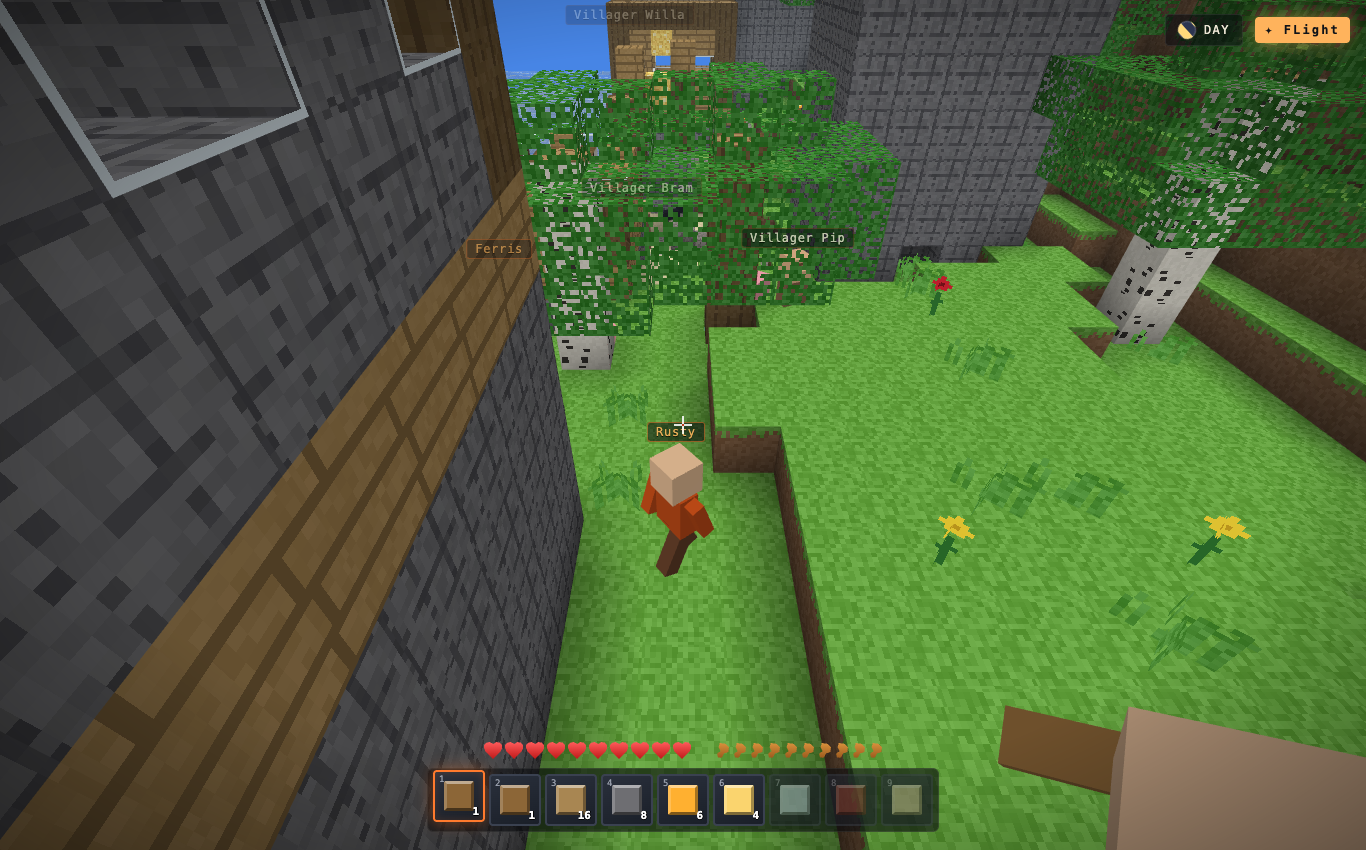
A villager at home: generated houses, name tags, paths, and birch trees near spawn
The reordering
I wrote recently that the value in this era is moving down the stack, away from applications and into the data layer, and that the one-person engineering pod is the most underrated shift happening inside non-tech companies. RustCraft is what that argument looks like when you let it out of the abstract.
Because notice what I actually did all day. I did not write code. I made product decisions, in plain language, at the rate I could think of them. The dogs should leap out of water. The agents should only build finished structures. New players should start with a sword and a pickaxe. Make it fit a phone screen properly. Each decision came back implemented, tested, and live on the public server, usually within the hour. That is not a faster version of software engineering. That is a different activity, closer to directing than to building, and it collapses the distance between deciding and shipping to nearly zero.
Now swap the game for your business. The pattern transfers exactly, and this is where the data layer argument and the frontier model argument become one argument. RustCraft's talking villagers are, structurally, just a model reaching through a secured server-side integration to do useful work in context. The deployment was the same pattern pointed at infrastructure: the model drove the hosting CLI, diagnosed an upload failure, wrote the fix, set the secrets, armed its own monitors, and probed production over live WebSockets until everything passed. A standard like MCP is the socket. A model like Fable 5 is the first appliance powerful enough to make every socket in the building worth wiring. Connect your systems once, securely, and this same intelligence that built a game before lunch will run your reporting, your reconciliations, your customer operations, at speeds and a level of judgment that simply had no precedent eighteen months ago.
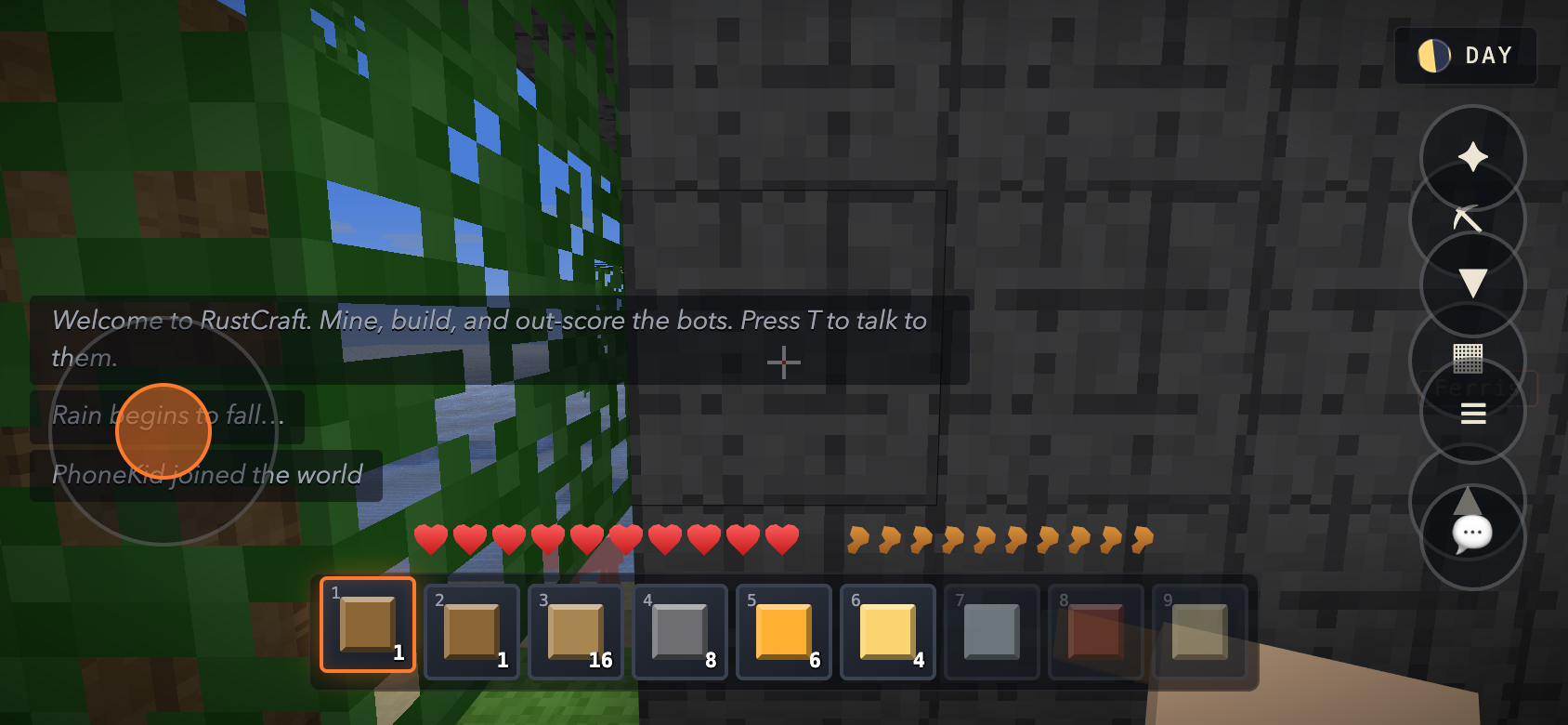
RustCraft on a phone: the same five-hundred-kilobyte client, touch controls and all.
A class of its own
Every release cycle someone declares a turning point, and most of those declarations compost quietly. So let me be precise about the claim. Fable 5 is the first generally available model where the limiting factor in a serious, multi-layered engineering project was unambiguously me: my clarity, my decisions, my willingness to keep asking. Not its correctness. Not its stamina. Not its judgment under ambiguity. I have run this experiment, in one form or another, on every frontier model since the experiments were worth running. This is the first time the bottleneck moved.
That is what a class of its own means in practice, and its effect on industry will not be subtle. The companies that internalize it now, that wire their data, hire the one excellent person instead of the department, and start making decisions at the speed this intelligence can execute them, will pull away from the ones still scheduling meetings about it. The gap will look unfair. It will not be unfair. It will be the compounding return on having understood, early, that the ground moved.
I asked for an impossible game on a Tuesday afternoon, and by evening my friends were getting out-mined by a robot named Clank on their phones. The era where that sentence is remarkable is already ending. The era it announces is just getting started.
\---
Screenshots: all images are unedited captures of RustCraft, taken during the build session described above. The game is live at https://rustcraft.velroi.com.
Contact the author
Thomas Kanz at [email protected]